
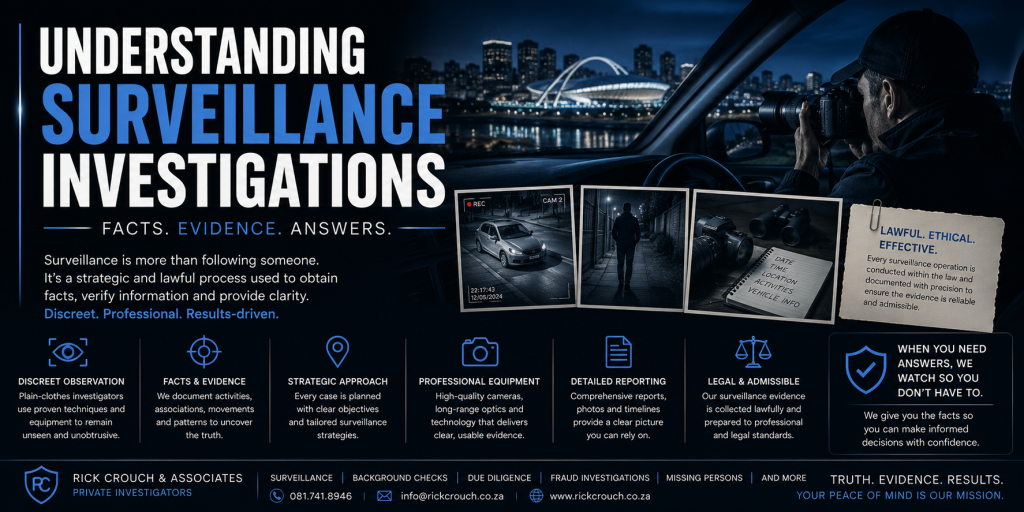
Understanding Surveillance Investigations
Surveillance is one of the most recognised investigative techniques, yet it is also one of the most misunderstood. Here we attempt to assist you in understanding surveillance investigations.
Many people imagine surveillance as simply “following someone.” In reality, professional surveillance involves careful planning, risk assessment, lawful observation and detailed documentation.
When conducted professionally, surveillance provides objective evidence that may assist businesses, attorneys, insurers and private individuals in making informed decisions.
What Is Surveillance?
Surveillance is the systematic observation of people, places, vehicles or activities for a legitimate investigative purpose.
The objective is not to make assumptions or accusations but to document factual observations.
Professional surveillance records:
- Activities
- Movements
- Times
- Locations
- Interactions
- Vehicles
- Photographic Evidence (where possible)
- Video Evidence (where possible)
Every observation should be accurately documented and supported by contemporaneous notes.
When Is Surveillance Appropriate?
Surveillance may be appropriate in a wide range of investigations.
Common examples include:
Insurance Investigations
- Disability Claims
- Injury Claims
- Workers’ Compensation
- Income Protection Claims
Corporate Investigations
- Employee Theft
- Workplace Misconduct
- Time Fraud
- Policy Violations
- Conflict of Interest
Fraud Investigations
- Insurance Fraud
- Procurement Fraud
- Benefit Fraud
- Asset Misappropriation
- Financial Misconduct
Litigation Support
Attorneys may request surveillance to assist with:
- Civil Litigation
- Criminal Defence
- Witness Verification
- Activity Documentation
Missing Person Investigations
Surveillance techniques may assist investigators in confirming an individual’s location, movements or associations.
How Professional Surveillance Is Planned
Successful surveillance begins long before investigators enter the field.
Planning often includes:
- Reviewing available information
- Assessing objectives
- Identifying locations
- Evaluating risks
- Determining operational requirements
- Establishing communication procedures
- Preparing equipment
Good planning reduces unnecessary risk and improves operational efficiency.
What Happens During Surveillance?
Professional investigators document observable facts.
This may include:
- Arrival and departure times
- Vehicle movements
- Locations visited
- Meetings with other individuals
- Activities observed
- Relevant photographs
- Video recordings where appropriate
Investigators avoid speculation and record only what they directly observe.
Surveillance Equipment
Professional surveillance may involve equipment such as:
- Digital Cameras
- Video Cameras
- Long-Range Lenses
- GPS Navigation
- Binoculars
- Drones
- Secure Communications Equipment
- Time Synchronisation Devices
- Note-Taking Systems
The equipment selected depends on the objectives and environment of the investigation.
Documentation Is Critical
One of the most important aspects of surveillance is accurate documentation.
Professional reports typically include:
- Date
- Time
- Location
- Weather Conditions (where relevant)
- Investigator Observations
- Photographs
- Video References
- Vehicle Information
- Summary of Activities
The quality of the report is often as important as the surveillance itself.
Is Surveillance Legal?
Professional surveillance must always be conducted in accordance with applicable laws and ethical standards.
Investigators should:
- Respect legal boundaries
- Avoid unlawful intrusion
- Conduct themselves professionally
- Preserve evidence appropriately
- Maintain client confidentiality
Every investigation should be planned with legal compliance in mind.
Common Misconceptions
“Surveillance Guarantees Results”
No.
Some assignments produce valuable evidence, while others confirm that no suspicious activity occurred. Both outcomes can be important.
“One Day Is Always Enough”
Not necessarily.
Some investigations require multiple operational days before meaningful observations are obtained.
“Investigators Can Follow Anyone Anywhere”
Professional investigators operate within legal and ethical limits. Certain locations or circumstances may restrict observation.
“Photographs Alone Tell the Whole Story”
Photographs provide context but are most valuable when accompanied by detailed notes explaining the circumstances in which they were taken.
Why Experience Matters
Effective surveillance requires patience, planning and sound judgment.
Experienced investigators understand:
- Operational Planning
- Risk Assessment
- Evidence Preservation
- Observation Techniques
- Professional Reporting
- Client Communication
- Court Expectations
Experience often makes the difference between collecting isolated observations and producing a coherent, evidence-based report.
Why Choose Rick Crouch & Associates?
Rick Crouch & Associates provides professional surveillance services throughout South Africa with more than 30 years of investigative experience.
Our surveillance services support:
- Attorneys
- Insurance Companies
- Businesses
- Government Organisations
- Financial Institutions
- Private Individuals
Every assignment is conducted professionally, confidentially and with the objective of documenting factual observations.
Need Professional Surveillance Services?
If you require professional surveillance in support of a legal matter, fraud investigation, insurance claim or corporate investigation, Rick Crouch & Associates can assist.
📞 Call: 081 741 8946
✉️ Email: info@rickcrouch.co.za
Request a Confidential Consultation
Related Articles
- What Does a Private Investigator Do?
- How to Choose a Private Investigator
- Fraud Investigations Explained
- Corporate Investigations: Protecting Your Business
- Background Investigations Explained
- Missing Person Investigations
- Digital Forensics: A Beginner’s Guide
- Preserving Digital Evidence