
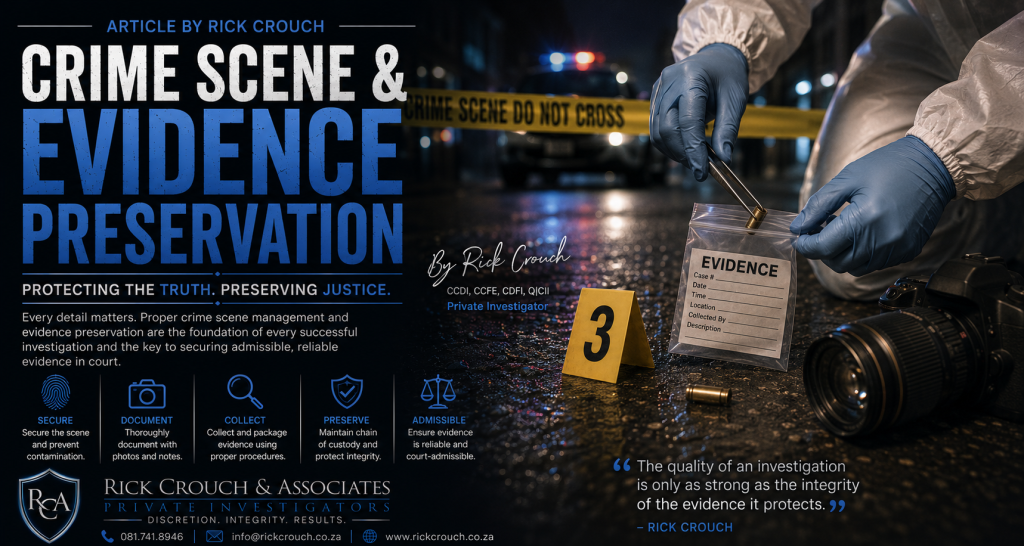
Crime Scene Preservation
Why Securing a Crime Scene Properly Can Make the Difference Between Conviction and Acquittal
By Rick Crouch
Private Investigator | Digital Forensic Investigator | Criminal Defence Investigator
The Importance of Crime Scene and Evidence Preservation
Every criminal investigation begins long before the laboratory analysis, witness interviews or courtroom testimony. It begins the moment the first responding officer, security officer or investigator arrives at the scene.
Having spent more than three decades investigating crimes, assisting legal teams and examining evidence, I can confidently say that the first few minutes at a crime scene often determine whether justice will ultimately be served.
A poorly protected crime scene can result in lost evidence, contaminated exhibits and unanswered questions. Conversely, a properly secured and documented crime scene can provide investigators with the physical and digital evidence needed to reconstruct events and identify those responsible.
The journey from crime to conviction—or exoneration—starts with crime scene preservation.
Why the First Responding Officer Matters
Arguably, the most important person at any crime scene is the first officer or responder to arrive.
Their decisions during the first few minutes may affect the entire investigation.
The responsibilities of the first responder typically include:
- Ensuring the safety of victims and the public.
- Determining whether suspects remain nearby.
- Establishing and securing the crime scene.
- Preventing contamination of evidence.
- Identifying potential witnesses.
- Preserving evidence until specialist investigators arrive.
Every action taken—or not taken—may later be examined in court.
Protecting the Crime Scene
One of the first priorities is preventing unnecessary changes to the scene.
Crime scenes are constantly at risk from two primary threats:
People
The greatest danger to evidence is usually well-intentioned people.
These may include:
- Curious bystanders
- Family members
- Neighbours
- Media
- Emergency personnel
- Police officers
- Security staff
Every unnecessary person entering the scene increases the risk of contamination.
Weather
Rain, wind, heat and sunlight can rapidly destroy valuable evidence such as:
- Bloodstains
- Shoe impressions
- Tyre tracks
- Fingerprints
- DNA
- Cartridge cases
- Fibres
Where practical, officers should protect vulnerable evidence using available materials such as tarpaulins, plastic sheeting or other suitable coverings until crime scene investigators arrive.
Establishing a Secure Perimeter
An effective crime scene should be secured using two controlled perimeters.
Outer Perimeter
The outer perimeter prevents unauthorized access by:
- Members of the public
- Media
- Neighbours
- Family members
- Non-essential personnel
This area should be clearly marked using crime scene tape.
Inner Perimeter
The inner perimeter identifies the actual area containing evidence.
Only authorised personnel should enter this area.
The space between the two perimeters becomes the operational staging area where investigators can establish equipment, park vehicles and coordinate resources without disturbing evidence.
Maintaining a Crime Scene Entry Log
Every person entering or leaving the crime scene should be recorded.
The entry log should include:
- Name
- Agency
- Time in
- Time out
- Purpose for entry
Maintaining an accurate log assists investigators in identifying legitimate fingerprints, footwear impressions and DNA that may later be encountered during forensic examination.
Less Is Often More
One of the most common mistakes made by inexperienced responders is doing too much.
The first responder should avoid:
- Moving evidence unnecessarily.
- Touching objects without reason.
- Opening drawers or cupboards.
- Rearranging furniture.
- Walking through unnecessary areas.
- Searching beyond what is necessary to ensure safety.
Every unnecessary action risks altering the scene.
When Evidence Must Be Moved
There are occasions when evidence must be disturbed.
Examples include:
- Removing a firearm from an injured person’s hand so emergency treatment can be provided.
- Moving dangerous objects to protect life.
- Preventing evidence from immediate destruction.
Whenever evidence must be moved, investigators should document:
- What was moved.
- Why it was moved.
- Who moved it.
- The original position.
- The new position.
Whenever possible, photographs should be taken before anything is disturbed.
Photograph Everything
One lesson I have learned throughout my career is simple:
You can never take too many photographs of a crime scene.
Photographs preserve the original condition of the scene before evidence is collected or moved.
They should document:
- Overall scene views
- Entry and exit points
- Individual rooms
- Evidence in context
- Close-up evidence
- Injuries where appropriate
- Vehicle positions
- Weather conditions
- Lighting conditions
Good photography often answers questions years after the investigation has concluded.
Preserving Digital Evidence
Modern crime scenes frequently contain valuable digital evidence.
This may include:
- Mobile phones
- Computers
- Tablets
- Smart watches
- CCTV systems
- USB drives
- Cloud-connected devices
One of the biggest mistakes first responders make is attempting to “look around” on electronic devices.
Simply:
- Moving a computer mouse
- Unlocking a phone
- Opening an application
- Switching a device on or off
may alter valuable evidence.
Digital devices should be examined by qualified digital forensic investigators using recognised forensic procedures designed to preserve evidence integrity.
Identifying Witnesses
The first responder should identify potential witnesses as early as possible.
Basic details should be obtained, including:
- Full name
- Contact information
- Relationship to the incident
However, lengthy interviews should generally be left to the lead investigator, who can conduct a structured interview without distraction from the immediate responsibilities of securing the scene.
Documentation Is Critical
Everything the first responder does should be documented.
Notes should include:
- Time of arrival
- Weather conditions
- Persons present
- Actions taken
- Evidence observed
- Safety concerns
- Statements made spontaneously by victims or witnesses
- Changes made to the scene
These notes may later become important during court proceedings.
Knowing When to Call Specialists
No investigator can be an expert in every discipline.
Professional investigations often require assistance from specialists such as:
- Crime Scene Investigators
- Digital Forensic Examiners
- Fingerprint Experts
- DNA Specialists
- Ballistics Experts
- Bloodstain Pattern Analysts
- Fire Investigators
- Forensic Pathologists
Recognising when specialist expertise is required is a sign of professionalism, not weakness.
Why Evidence Preservation Matters
Crime scene preservation is about far more than collecting evidence.
It protects the integrity of the entire investigation.
Properly preserved evidence can:
- Identify offenders.
- Eliminate innocent suspects.
- Support successful prosecutions.
- Assist defence teams.
- Reveal previously overlooked facts.
- Reconstruct the sequence of events.
- Ensure justice is based on reliable evidence rather than assumptions.
Poor evidence preservation can have the opposite effect, leading to contaminated evidence, unreliable conclusions and, ultimately, miscarriages of justice.
Professional Crime Scene Assistance
At Rick Crouch & Associates, we understand the importance of preserving physical and digital evidence from the earliest stages of an investigation.
Our services include:
- Crime scene documentation
- Digital forensic examinations
- Mobile phone forensics
- Computer forensics
- Criminal defence investigations
- Evidence review
- Chain of custody documentation
- Independent investigative support for attorneys and businesses
Our approach is based on professionalism, objectivity and evidence—not assumptions.
Conclusion
Every successful investigation begins with a properly preserved crime scene.
Whether the incident involves homicide, fraud, burglary, cybercrime or civil litigation, the quality of the investigation often depends on the quality of the evidence collected in those critical first moments.
The responsibility placed on first responders is enormous. By understanding the principles of crime scene preservation, recognising the limits of their role and calling upon specialist expertise when required, they help ensure that justice is based on reliable, uncontaminated evidence.
As investigators, our responsibility is not simply to collect evidence—it is to protect the truth.
Frequently Asked Questions
Why is crime scene preservation important?
Proper preservation protects physical and digital evidence from contamination, loss or alteration, ensuring investigators can accurately reconstruct events and support legal proceedings.
Who should enter a crime scene?
Only authorised personnel with a legitimate investigative or emergency purpose should enter a secured crime scene. Every entry and exit should be documented.
Should a first responder collect evidence?
Generally, evidence collection should be left to trained crime scene investigators unless immediate action is necessary to preserve life or prevent evidence from being destroyed.
Can mobile phones and computers contain important evidence?
Yes. Smartphones, computers and other digital devices often contain communications, location data, photographs and other evidence. They should be handled by qualified digital forensic investigators to avoid altering the data.
What is a chain of custody?
A chain of custody is the documented record showing who collected, handled, transferred and stored evidence. Maintaining this record helps demonstrate the integrity and authenticity of evidence throughout an investigation.